The Single-Channel Problem
For most of the last decade, outbound sales had a clear playbook: build a list, find emails, send cold outreach, follow up three times, repeat. LinkedIn entered the mix later as a separate motion — connection requests, InMail, the occasional voice note. Most teams treated them as parallel operations. Same SDR, different tabs, no coordination between them.
That approach is cracking. Reply rates on cold email have been declining year-over-year as inboxes get better at filtering automated sequences. LinkedIn connection acceptance rates have softened as prospects become more selective about who they let into their network. Both channels, in isolation, are becoming less effective — not because the prospects aren't there, but because the signal-to-noise ratio is broken.
The teams consistently outperforming their quota in 2025 have solved this by not choosing. They run LinkedIn and email simultaneously. And they fuel both with a content layer that does the warming work before the first message ever gets sent. This is the three-channel outbound engine — and it's not a complicated theory. It's a practical system you can build in a week.
The Core Principle
No single outbound channel is broken. What's broken is the assumption that one channel is enough. The engine works because each channel covers the other's blind spots.
How the Three-Channel Engine Works
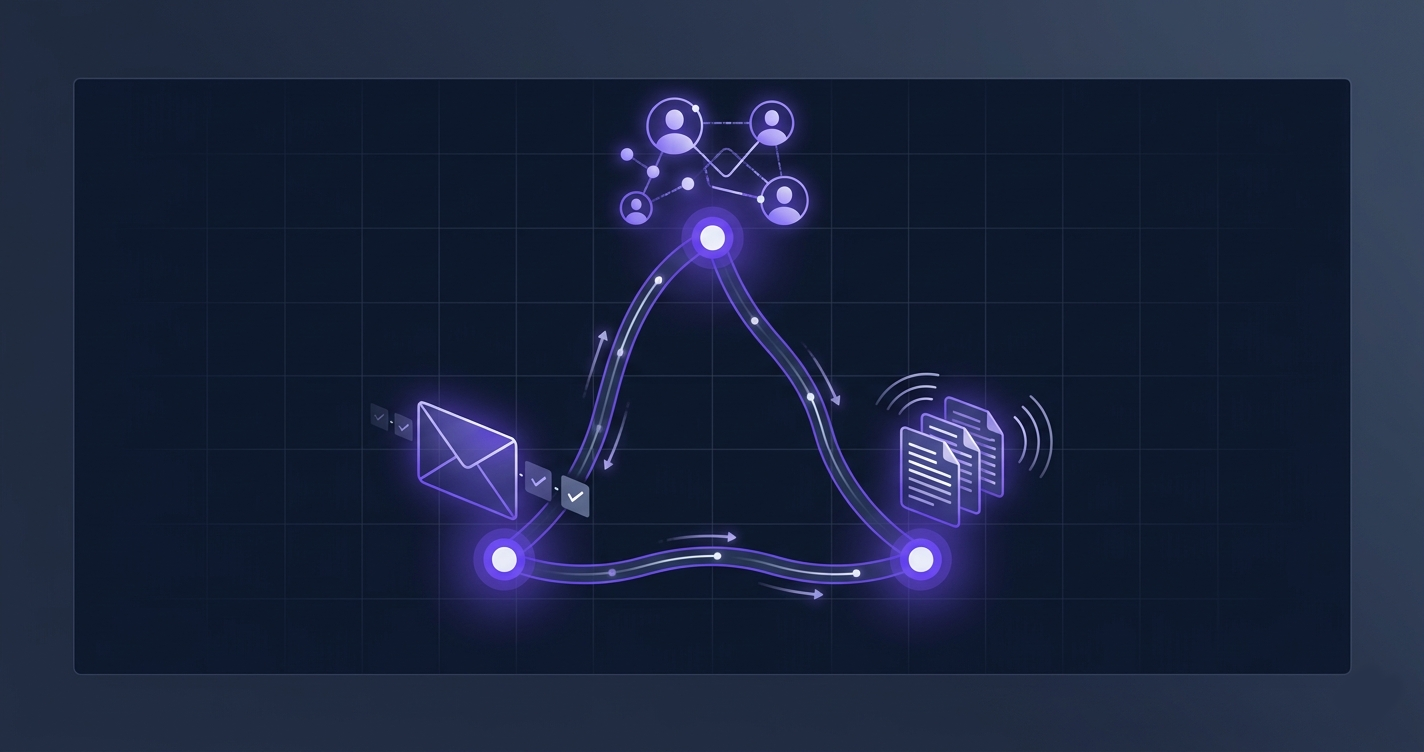
The engine has three interdependent layers that run concurrently, not sequentially. Understanding how they interact is more important than understanding each one individually.
Layer 1 — Content (The Warm-Up)
Consistent LinkedIn posts build familiarity with your ideal buyer pool before any direct outreach begins. When your name appears in a prospect's feed regularly, your connection request and first message land on already-recognised ground rather than cold.
Layer 2 — LinkedIn Sequences (The Initiation)
Automated LinkedIn campaigns initiate direct contact — connection requests, personalised follow-up messages, and InMails structured around what you know about each prospect's situation. This is where the conversation starts.
Layer 3 — Email (The Second Touch)
Email enters the sequence after LinkedIn contact has been established. A prospect who has already seen your content and your LinkedIn connection request approaches your email from a completely different frame than someone receiving a cold email with zero prior context.
The reason the engine outperforms any single channel is cumulative familiarity. By the time a prospect receives your email, they have already encountered your ideas (content), seen your name in their connection requests (LinkedIn), and potentially accepted or at least consciously considered your network request. The email is the third signal, not the first — and it lands accordingly.
Layer 1: Content Does the Warming Your Sequences Can't
The biggest misconception about content for sales reps is that it's a marketing activity — something the marketing team handles while SDRs do real work. This is backwards. For outbound teams in 2025, LinkedIn content is a sales activity. It is the highest-leverage thing a rep can do to increase their sequence reply rates without sending a single additional message.
The mechanism is straightforward. LinkedIn's algorithm distributes your posts to a percentage of your existing connections and their connections. If your target buyers are already in your network — or if your content is engaging enough to reach their connections — they encounter your thinking before you ever reach out directly. When your connection request arrives, your name is familiar. When your first message lands, they have a frame of reference for who you are.
"The best cold message is the one that doesn't feel cold — because they already know who you are."
— Common pattern in top-quartile outbound teams
The content that works for outbound warming shares three characteristics:
It addresses your buyer's specific problem, not your product
Posts about the problems your buyers face — not features you offer — position you as someone worth listening to before you've asked for anything. "Why cold email open rates are falling in 2025" gets more engagement from sales leaders than "Why you should try our platform."
It is specific enough to trigger recognition
Generic content about "the importance of sales" reaches nobody in particular. Content about "why SDR reply rates collapse after step 3 in a 6-step sequence" is specific enough that a VP of Sales reading it thinks: this person understands my exact situation. Specificity creates the familiarity that matters.
It posts consistently — not in bursts
Three posts a week for eight weeks outperforms twelve posts in one week followed by silence. Consistent presence in a buyer's feed over time creates familiarity that a single viral post can't. The goal isn't virality — it's sustained recognition within your target segment.
2.7×
Higher acceptance rate
for reps posting content vs. silent profiles
3×
Posts per week
minimum threshold for consistent feed presence
6–8 wks
Warmth build time
before content noticeably lifts sequence rates
Layer 2: Building the LinkedIn Sequence
With a content foundation in place, LinkedIn sequences stop being cold and start being the second impression. The connection request lands after your prospect has seen your content. Your first message after connecting arrives from someone they recognise — not a stranger.
The structure of the LinkedIn sequence matters more than most SDRs realise. Linear drip campaigns — message 1, wait 3 days, message 2, wait 3 days, message 3 — treat every prospect identically regardless of what they actually do. Branching sequences adapt.
A branching LinkedIn sequence for the three-channel engine looks like this:
Day 0: Connection request — short, personalised note referencing something specific (their post, their company, shared context)
→ IF accepted within 3 days:
Day 4: First message — value-first, no pitch. Reference their situation, share a relevant insight or resource. One question at the end.
→ IF replied: remove from sequence, handle manually in inbox
→ IF opened, no reply (Day 7): Second message — shorter, different angle, still no hard pitch
→ IF no reply (Day 11): Email sequence triggers (see Layer 3)
→ IF not accepted within 5 days:
Day 6: InMail to LinkedIn profile — separate message, doesn't require connection
Day 10: Email sequence triggers regardless
The branching logic is what separates high-performing sequences from average ones. A prospect who accepted your connection request immediately has signalled something different than one who hasn't responded in five days. They deserve a different next step — and branching logic delivers it automatically.
Layer 3: Email as the Second Channel, Not the First
The most important shift in thinking about the email layer is its role. In a single-channel outbound motion, email is your only shot — it has to carry the entire relationship-building burden in a subject line and 150 words. In the three-channel engine, email enters after LinkedIn has already established a touchpoint. The prospect receiving your email has already seen your content, already encountered your name on LinkedIn, and already made a decision — even if unconsciously — about who you are.
This changes what your email can do. You're not introducing yourself from scratch. You're following up on a relationship that already exists, however briefly. That framing — even when you're technically still in the cold outreach phase — produces a meaningfully different response rate.
Three email templates that work specifically in this second-channel context:
Subject: Different channel, same question
Hey [First Name] — reached out on LinkedIn last week but figured I'd try here too. Teams like [Company] usually come to us when [specific trigger: e.g. their outbound volume scales but reply rates don't]. Familiar problem? If yes, 15 minutes this week would be worth it. If not, I'll leave you alone.
Subject: You liked my post about [topic]
Hey [First Name] — saw you engaged with my post about [specific topic] last week. That's actually the exact problem we help teams like [Company] solve. Worth expanding on what I wrote? I can show you what it looks like in practice in 15 minutes.
Subject: Closing your file
Hey [First Name] — I've reached out a few times across LinkedIn and email. No response usually means one of two things: wrong timing, or wrong fit. Either way, I'm not going to keep pushing. If [specific pain point] ever becomes a priority, my contact details are below. Otherwise — best of luck with [Company].
Synchronising All Three Channels Without Losing Your Mind
The operational complexity of running three channels simultaneously is the reason most teams don't do it. Switching between a LinkedIn tool, an email platform, a content scheduler, and a CRM for every prospect at every stage isn't sustainable — it's how reps burn out and sequences collapse mid-cycle.
The engine only works at scale when the tooling eliminates the switching cost. Practically, this means three things need to happen from a single workspace:
LinkedIn sequences and email steps in the same campaign
If your LinkedIn tool and email tool are separate platforms with no coordination, you're managing two sequence states per prospect simultaneously — which prospect received step 3 on LinkedIn, which triggered email step 1 — across potentially hundreds of contacts. This collapses quickly. The sequence builder needs to handle both channels in a single branching flow, so the system tracks state for you.
Email addresses found without leaving the prospecting workflow
The email layer requires verified contact details. If finding emails means opening Apollo, searching by name, copying the address, and pasting it back into a sequence — you'll do it for your top ten prospects and skip it for everyone else. Email finding needs to be a one-click action on any prospect profile, or a triggered step in the sequence itself.
Content creation that doesn't take three hours per post
Three posts a week is sustainable only if each post takes under 20 minutes to produce. This means either a strong personal writing habit, or AI assistance that doesn't require extensive editing. Most reps will use the latter — and that's fine, provided the output sounds like them and not like a press release. The quality bar for feed-warming content is "genuinely useful and specific," not "highly polished."
All three channels. One platform. No switching.
ConnectionQ's sequence builder runs LinkedIn and email steps in a single branching flow. Email Finder adds verified addresses in one click from any prospect profile. AI Post Studio creates post content using 7 proven frameworks across text, image, and carousel formats — in under 3 minutes per post. The three-channel engine doesn't require three separate tools.
See All FeaturesWhat the Engine Looks Like When It's Running Well
When all three channels are coordinated and the tooling handles the sequencing logic, the rep's daily workflow becomes surprisingly simple. Morning: check the inbox for replies that came in overnight, handle the ones that need manual response. During the day: review which prospects advanced to email stage, approve or tweak the outgoing messages. Content: one post drafted and scheduled for the day.
The sequences are running in the background across LinkedIn and email simultaneously. The rep isn't managing individual touchpoints — they're managing conversations. The system handles the touchpoints.
The metrics look different too. Single-channel LinkedIn outbound teams typically see connection acceptance rates of 25–35% and reply rates on messages of 8–15%. Teams running the three-channel engine report acceptance rates of 45–60% (content warming at work) and reply rates — across both LinkedIn and email combined — of 20–35% for well-targeted prospect lists. The improvement isn't marginal. It's the kind of number that makes leadership re-evaluate the entire outbound motion.
+60%
Connection acceptance
vs. cold LinkedIn-only outreach
2.4×
Reply rate lift
across combined LinkedIn + email channels
~20 min
Daily active management
once the engine is running at full speed
Five Mistakes That Kill the Engine
Most teams that attempt the three-channel approach stumble on the same predictable mistakes. Here's what to watch for.
Starting all three channels simultaneously from day one
The engine runs best when content has been publishing for 4–6 weeks before active sequencing starts. Launching LinkedIn sequences and email campaigns the same week you post your first piece of content skips the warm-up phase entirely. Start with content, let it run, then add sequences once you have some presence in your target audience's feed.
Sending the same message on LinkedIn and email
If your LinkedIn message and your email say the same thing, a prospect who sees both will notice — and it will feel like volume outreach with extra steps. Each channel needs a different angle: LinkedIn is typically more conversational and short; email can carry slightly more context. The message that was appropriate as a LinkedIn DM will feel off as a formal email, and vice versa.
Content that's about you, not your buyer
The fastest way to nullify the content warm-up is to post promotional content — product announcements, company news, sales metrics you hit. Your ideal buyer doesn't care about your quarter. They care about their problem. Content that earns recognition is content that names their specific situation and adds something useful to it. Save the company updates for your brand page.
Treating a non-reply as a no
Most non-replies are timing issues, not rejection. The person saw your LinkedIn request on a bad day, missed your email, and moved on. Running all three channels over a 2–3 week window gives you multiple impression opportunities without being aggressive on any single channel. A prospect who doesn't accept your LinkedIn request might still reply to your email four days later.
Optimising each channel separately instead of the system
The three-channel engine is a system. Optimising your LinkedIn acceptance rate in isolation, without looking at how it affects email reply rates for the same cohort, gives you an incomplete picture. Measure the engine's output — pipeline generated, conversations started, meetings booked — not the vanity metrics of each individual channel. The channels exist to serve the output, not the other way around.
Building Your Engine: The 30-Day Starting Plan
You don't need to build all three channels perfectly before you start. You need to start them in the right order and let the system compound over time. Here's a realistic 30-day ramp:
Days 1–7: Content foundation
Write and publish three pieces of content this week. Each should address a specific problem your ideal buyer faces — no product mentions. Schedule two more for next week. Set up your content calendar for the month. This week is exclusively about content — don't touch sequences yet.
Days 8–14: LinkedIn sequence setup
Build your first branching LinkedIn sequence: connection request with personalised note, post-acceptance follow-up, InMail for non-accepters. Add the first prospect list. Keep the list tight — 50–100 highly targeted prospects — and start running. Content continues publishing on schedule.
Days 15–21: Add email as a second channel
Find emails for the prospects who haven't replied on LinkedIn. Build your first email sequence — three messages, spaced 3–4 days apart — that references the LinkedIn outreach without repeating it. Trigger email sequences automatically for prospects who reach day 11 with no LinkedIn reply. Monitor reply rates across both channels, not separately.
Days 22–30: Review and scale
You now have 2–3 weeks of data from the first cohort. Review the combined reply rate: LinkedIn replies + email replies, divided by total prospects entered. Compare this to your single-channel baseline. Identify the content topics that generated the most engagement and write three more posts in that direction. Scale the prospect list that's performing. Leave the underperforming one alone until you've identified the message angle issue.
At the end of 30 days, the engine is running — not at full power, but running. The content is warming new prospects every day. The LinkedIn sequence is generating connections and conversations. The email layer is catching prospects who slipped through LinkedIn. And you're spending less time on each individual touchpoint than you were before, because the system handles the tracking.
The second month is about refinement — better content angles, tighter message copy, prospect lists filtered by tech stack or intent signal. Month three is where the compounding effect becomes obvious: prospects who engaged with your content in week one are now 8 weeks further into familiarity with your name, and some of them are starting to reach out to you. That's the engine running as designed.
The long game
The three-channel engine gets more effective over time, not less. Every piece of content builds your audience. Every sequence adds connections to your network. Every email adds data about what resonates. The teams that commit to it for six months don't want to go back to single-channel outreach. Not because it's ideologically superior — because the numbers are simply better.

Written by
James Whitfield
Head of Growth at ConnectionQ
James leads growth at ConnectionQ, helping B2B sales teams build predictable pipeline through multi-channel outreach. He's written about LinkedIn automation, cold email, and sales development for over five years.